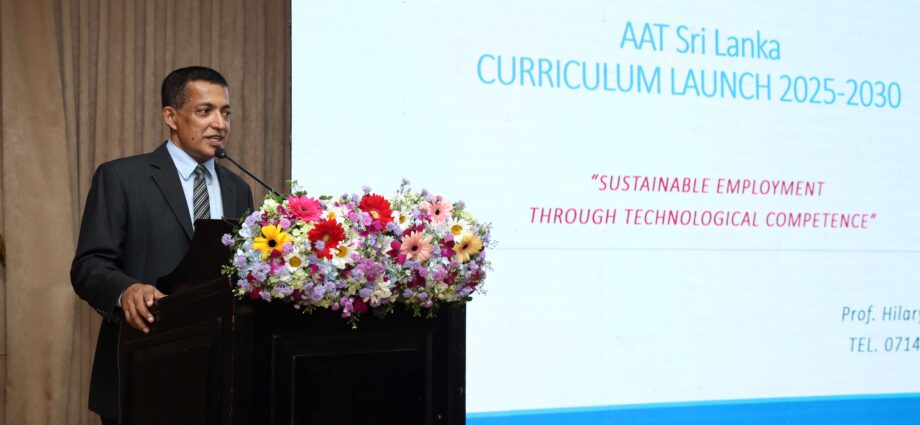
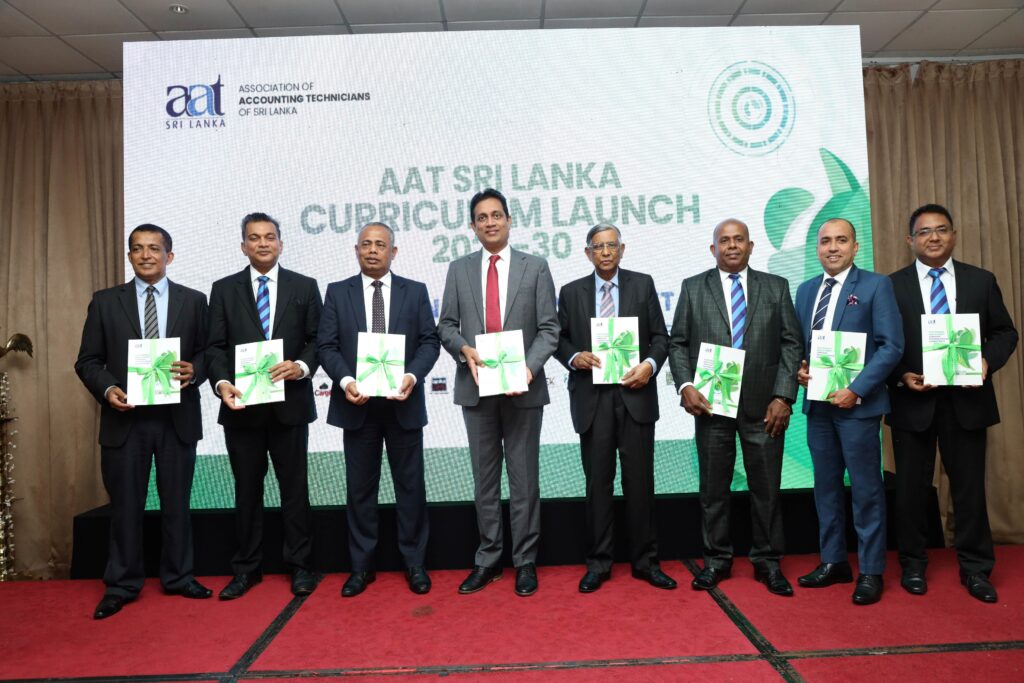
The Association of Accounting Technicians of Sri Lanka (AAT Sri Lanka) officially announces the launch of its Curriculum 2025–2030, themed “Sustainable Employment through Technological Competence,” effective from the July 2026 examinations, marking a significant milestone in its commitment to academic excellence and innovation.
The 2020–2025 framework is being replaced by this new curriculum, which represents a strategic shift in professional accounting education. It was carefully designed to be in line with the rapidly advancing technology, sustainability disclosure standards, and evolving standards for accounting education around the world. This initiative, which goes beyond a routine syllabus update, reinforces AAT Sri Lanka’s commitment to strengthening the role of middle-level accounting professionals in a rapidly digitalising global economy and future-proofing accounting careers.
AAT Sri Lanka was established in 1987 to address the country’s need for skilled accounting technicians to support Sri Lanka’s corporate and SME sectors. Since then, it has developed into a leading professional organization with local and global recognition that influences accounting and business professionals locally and internationally.
The AAT curriculum 2025-2030 explicitly addresses how artificial intelligence, automation, blockchain technology, enterprise resource planning systems, cybersecurity risks, business analytics, digital reporting, and sustainability disclosures are transforming the accounting industry. With digital literacy, sustainable accounting, ethical leadership, and analytical capabilities at its foundation, the revised structure equips students with the knowledge, skills, attitudes, and mindset needed to succeed in a technology-driven business environment. It clearly communicates one compelling promise – that the new AAT Curriculum 2025–2030 guarantees sustainable employment through technological competence.
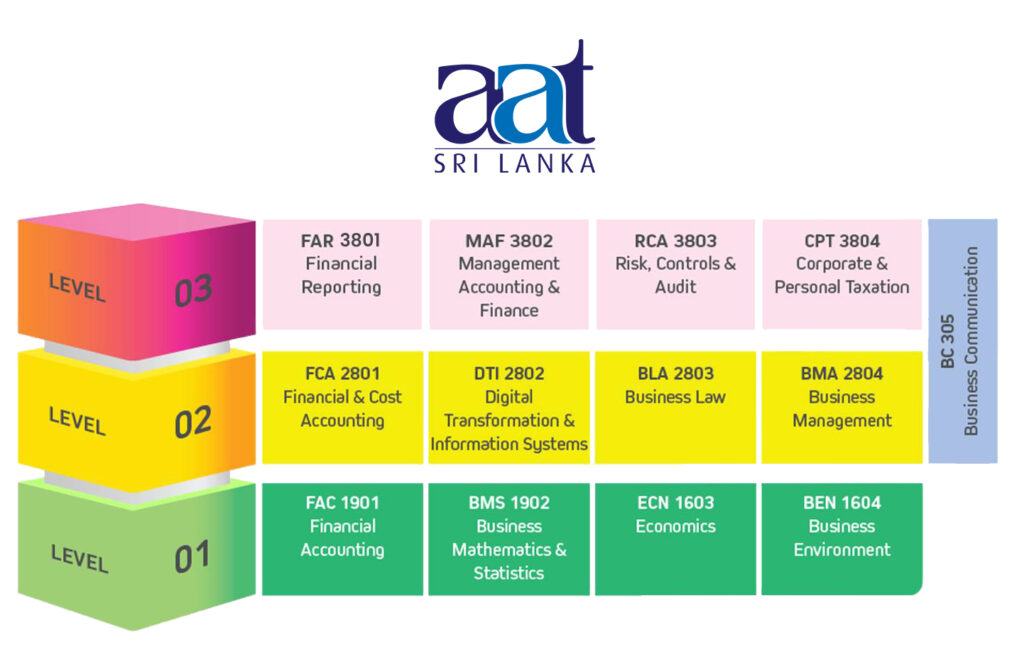
The curriculum is organised under four integrated pillars: Accounting and Finance, Performance Analysis and Management, Legal, Taxation and Auditing, and Digital Transformation and Communication. It is divided into three progressive levels with thirteen courses. Students are introduced to emerging technologies such as blockchain fundamentals, ERP systems, IoT concepts, cybersecurity frameworks, artificial intelligence applications, and ethical considerations in digital environments. To ensure compliance with global disclosure expectations, sustainability and integrated reporting principles are incorporated into the new curriculum. The curriculum also maintains alignment with the A/L Commerce stream, providing a seamless progression pathway for school leavers seeking a professional qualification in a shorter time frame.
In addition to academic study, the qualification includes a mandatory one-year Professional Training Programme completed under supervision in a digital working environment. Finalists who pass the AAT are qualified to join the Association of Accounting Technicians of Sri Lanka. This industry-driven approach guarantees that graduates are analytically strong, ethically grounded, digitally skilled, and completely prepared for the modern workplace. It is complemented by a structured People and Leadership Skills curriculum.
Professional mobility and career acceleration are significantly enhanced by the new curriculum. Leading professional bodies like the Institute of Chartered Accountants of Sri Lanka, CIMA, ACCA, CMA Sri Lanka, IPA Australia, IFA UK, local and foreign universities continue to benefit from exemptions to qualifying members and AAT passed finalists (Diploma holders in Accounting & Business). Notably, under the new structure, AAT-passed finalists under the new AAT curriculum are exempted from all four technical subjects at CA Sri Lanka’s Business Level, allowing them to advance to the Corporate Level after completing the Business Capstone at business level of CA Sri Lanka. Students now have a clear, efficient, and internationally recognised pathway to advanced professional and academic qualifications thanks to this strengthened alignment.
Additionally, the Curriculum 2025–2030 provides unparalleled accessibility and convenience. In order to start their professional journey right away, students who complete their A/L exams in January 2026 and those who complete their O/L exams in February 2026 can register with AAT Sri Lanka pending their results. Students can complete the qualification’s full academic component in 12 to 18 months, after which they will get structured professional training. The AAT qualification guarantees inclusivity and nationwide accessibility, making professional education accessible throughout Sri Lanka. It is offered at reasonable prices and is taught in Sinhala, Tamil, and English. It is an investment for the future rather than just a qualification.
Prof. Hilary E. Silva, Senior Professor at the University of Sri Jayewardenepura and Consultant of the AAT Curriculum Development Project 2025–2030, stated, “This curriculum prepares future middle-level accounting professionals to meet evolving global challenges with enhanced digital competencies by bridging the gap between professional learning and industry expectations. I have no doubt that this initiative will significantly contribute to the professional growth of AAT students and enhance AAT Sri Lanka’s influence in shaping the next generation of middle-level accounting professionals.”
For more information, visit www.aatsl.lk.
END